Говорим си за Боговете, Човека, Вселената, Философите и Живота

  • 33 277
  • 719
  •   1
Отговори
# 210
  • Мнения: 43 036
Отваря се, да Simple Smile Аз си изтеглих ексела, но още не съм го разглеждала подробно.

# 211
  • Чужбина
  • Мнения: 11 946
Отваря се, да Simple Smile Аз си изтеглих ексела, но още не съм го разглеждала подробно.

Чакайте и тука да го сложим това лъвче:

# 212
  • Мнения: 7 005
Ели,помощта е взаимна..Надявам се да стигнем до там,където се бях запътила преди..

п.п.Свалила съм "ексела",тенкс

# 213
  • Чужбина
  • Мнения: 11 946
Момичета, ето тука се вижда някои синхроничности м/у легендарни личности и Библията:

https://en.wikipedia.org/wiki/List_of_legendary_kings_of_Britain

# 214
  • Мнения: 43 036
Еней къде се вписва? - още не съм разгледала подробно, но като родоначалник на Рим би трябвало да се споменава из източниците...

# 215
  • Мнения: 7 005
Aeneas. Aeneas was a Trojan hero in Greek mythology, son of the prince Anchises and the goddess Aphrodite. He is more extensively mentioned in Roman mythology, and is seen as an ancestor of Remus and Romulus, founders of Rome.

https://www.google.com/search?sxsrf=ACYBGNRc9bBNuhUeTvuWsYfPh-ff … dUDCAs&uact=5


Anchises (/ænˈkaɪsiːz/;[1] Greek: Ἀγχίσης, Ankhísēs) was a member of the royal family of Troy in Greek and Roman legend. He was said to have been the son of King Capys of Dardania and Themiste, daughter of Ilus, who was son of Tros. He is most famous as the father of Aeneas and for his treatment in Virgil's Aeneid.[2] Anchises' brother was Acoetes, father of the priest Laocoon.[3]
https://en.wikipedia.org/wiki/Anchises

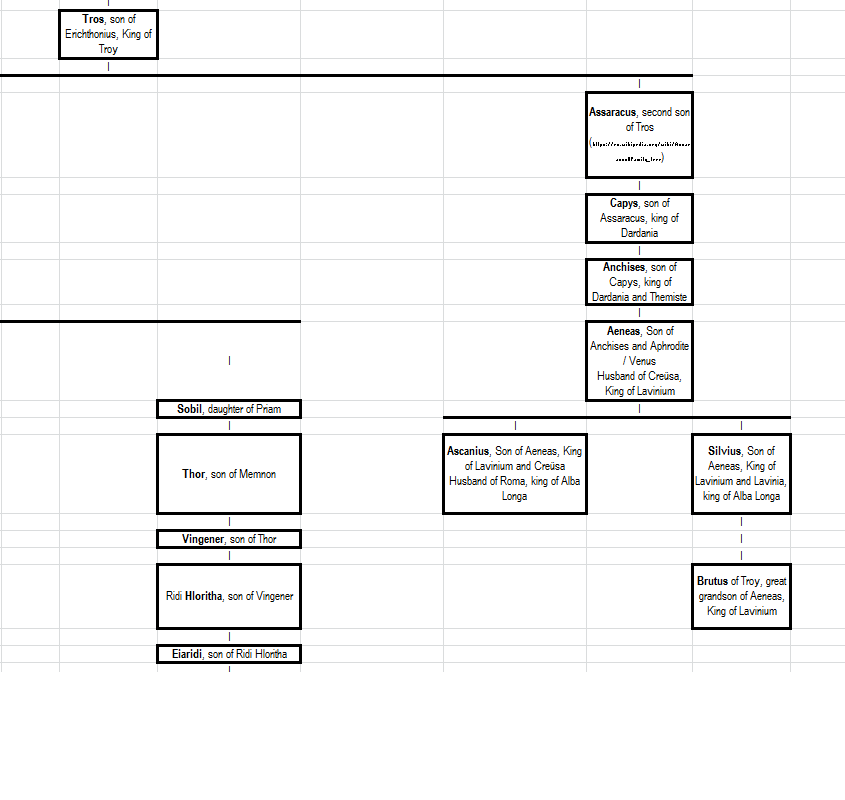
Еней е пра внук на Трос .Баща му Анксес е сина на Темисте,дъщеря на Илус,който пък син на Трос,

# 216
  • Мнения: 43 036
Имах предвид дали някой от по-късните владетели го приема за свой родоначалник.

# 217
  • Мнения: 7 005
Правнук е на Трост..После ще видим кво ще излезне..

На Еней брат му

 Acoetes
From Wikipedia, the free encyclopedia
Jump to navigationJump to search
Acoetes (Ancient Greek: Ἀκοίτης, via Latin Ăcoetēs) was the name of three men in Greek and Roman mythology.

Acoetes, a fisherman who helped the god Bacchus.[1]
Acoetes, father to the Trojan priest Laocoön, who warned about the Trojan Horse. As the brother of Anchises, he was therefore the son of King Capys of Dardania and Themiste, daughter of King Ilus of Troad.[2]
Acoetes, an aged man who was the former squire Evander in Arcadia, before the latter emigrated to Italy.[3]
Acoetes, a soldier in the army of the Seven against Thebes. When this army hit the Thebes for the first time on the plain, a fierce battle took place at the gates of the city. During these fights Agreus, from Calydon, cut off the arm of the Theban Phegeus. The severed limb fell to the ground while the hand still held the sword. Acoetes, who came forward, was so terrified of that arm that he hit it with his own sword.[4]

https://en.wikipedia.org/wiki/Acoetes

# 218
  • Чужбина
  • Мнения: 11 946
Еней къде се вписва? - още не съм разгледала подробно, но като родоначалник на Рим би трябвало да се споменава из източниците...

Еней Aeneas ли е?

"Aeneas, Son of Anchises and Aphrodite / Venus Husband of Creüsa, King of Lavinium"

"Ascanius, Son of Aeneas, King of Lavinium and Creüsa Husband of Roma, king of Alba Longa"

"Silvius, Son of Aeneas, King of Lavinium and Lavinia, king of Alba Longa"

Ascanius и Silvius са бащата и чичото (тука има различни версии) на Brutus of Troy, great grandson of Aeneas, King of Lavinium.

# 219
  • Мнения: 7 005
Да.На гр.се произнася Енеа(с),което е много близко до думата им за 9

# 220
  • Чужбина
  • Мнения: 11 946
Момичета, а Один в легендите как е представен точно?

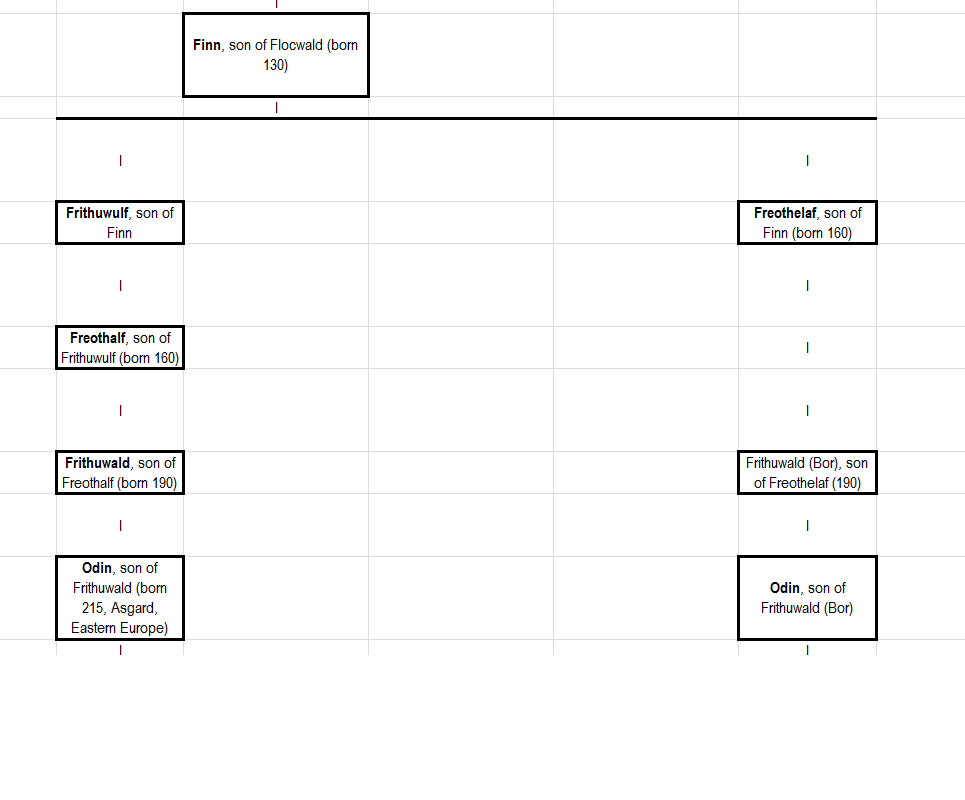
Сори за много тъпия въпрос, но нещо се обърках с произхода му. Финн има двама сина ...

# 221
  • Мнения: 43 036
Один е господарят на Скандинавските богове. Магьосник, едноок, много интелигентен и лукав (което по принцип не е типично за върховен бог).
Няма много запазени легенди за него (както и за останалите, всъщност).
Нещо интересно - той е баща на много човешки царе и герои; имал навика да помага на герои, като в определен момент ги предава (така че да бъдат убити) и събира душите им, за да си създаде армия от герои, която да му помогне в последния сблъсък срещу Локи - Рагнарьок.
Локи не му е син - осиновен, или какъвто и да е (подчертавам го, заради объркването с марвелските филми), а нещо като побратим, но в крайна сметка се превръщат във врагове.
Один е първообраз на Дядо Коледа))

https://bg.wikipedia.org/wiki/%D0%9E%D0%B4%D0%B8%D0%BD

# 222
  • Мнения: 7 005
Скрит текст:
Odin (/ˈoʊdɪn/;[1] from Old Norse: Óðinn, IPA: [ˈoːðinː]) is a widely revered god in Germanic mythology. In Norse mythology, from which stems most surviving information about the god, Odin is associated with wisdom, healing, death, royalty, the gallows, knowledge, war, battle, victory, sorcery, poetry, frenzy, and the runic alphabet, and is the husband of the goddess Frigg. In wider Germanic mythology and paganism, the god was known in Old English as Wōden, in Old Saxon as Wōdan, and in Old High German as Wuotan- бел.Какво - Вотан
Odin is a prominently mentioned god throughout the recorded history of the Germanic peoples, from the Roman occupation of regions of Germania through the tribal expansions of the Migration Period and the Viking Age. In the modern period, Odin continued to be acknowledged in the rural folklore of Germanic Europe. References to Odin appear in place names throughout regions historically inhabited by the ancient Germanic peoples, and the day of the week Wednesday bears his name in many Germanic languages, including English.

In Old English texts, Odin holds a particular place as a euhemerized ancestral figure among royalty, and he is frequently referred to as a founding figure among various other Germanic peoples, such as the Langobards. Forms of his name appear frequently throughout the Germanic record, though narratives regarding Odin are mainly found in Old Norse works recorded in Iceland, primarily around the 13th century. These texts make up the bulk of modern understanding of Norse mythology.

In Old Norse texts, Odin is depicted as one-eyed and long-bearded, frequently wielding a spear named Gungnir, and wearing a cloak and a broad hat. He is often accompanied by his animal companions and familiars—the wolves Geri and Freki and the ravens Huginn and Muninn, who bring him information from all over Midgard—and rides the flying, eight-legged steed Sleipnir across the sky and into the underworld. Odin is the son of Bestla and Borr and has two brothers, Vili and Vé. Odin is attested as having many sons, most famously the gods Thor (with Jörð) and Baldr (with Frigg), and is known by hundreds of names. In these texts, he frequently seeks greater knowledge, at times in disguise (most famously by obtaining the Mead of Poetry), makes wagers with his wife Frigg over the outcome of exploits, and takes part in both the creation of the world by way of slaying the primordial being Ymir and giving the gift of life to the first two humans Ask and Embla. Odin has a particular association with Yule, and mankind's knowledge of both the runes and poetry is also attributed to him, giving Odin aspects of the culture hero.

In Old Norse texts, female beings associated with the battlefield—the valkyries—are associated with the god and Odin oversees Valhalla, where he receives half of those who die in battle, the einherjar. The other half are chosen by the goddess Freyja for her afterlife location, Fólkvangr. Odin consults the disembodied, herb-embalmed head of the wise being Mímir for advice, and during the foretold events of Ragnarök, Odin is told to lead the einherjar into battle before being consumed by the monstrous wolf Fenrir. In later folklore, Odin appears as a leader of the Wild Hunt, a ghostly procession of the dead through the winter sky. He is associated with charms and other forms of magic, particularly in Old English and Old Norse texts.

Odin is a frequent subject of study in Germanic studies, and numerous theories have been put forward regarding his development. Some of these focus on Odin's particular relation to other figures; for example, the fact that Freyja's husband Óðr appears to be something of an etymological doublet of the god, whereas Odin's wife Frigg is in many ways similar to Freyja, and that Odin has a particular relation to the figure of Loki. Other approaches focus on Odin's place in the historical record, a frequent question being whether the figure of Odin derives from Proto-Indo-European mythology, or whether he developed later in Germanic society. In the modern period, Odin has inspired numerous works of poetry, music, and other forms of media. He is venerated in most forms of the new religious movement Heathenry, together with other gods venerated by the ancient Germanic peoples; some branches focus particularly on him.
https://en.wikipedia.org/wiki/Odin


Паганизъм
https://bg.wikipedia.org/wiki/%D0%95%D0%B7%D0%B8%D1%87%D0%B5%D1% … D1%82%D0%B2%D0%BE

Паганец или поганец(второто е и дума за плъх)


In Germanic mythology, Thor (/θɔːr/; from Old Norse: Þórr, runic ᚦᚢᚱ þur) is a hammer-wielding god associated with thunder, lightning, storms, oak trees, strength, the protection of mankind and also hallowing and fertility. Besides Old Norse Þórr, extensions of the god occur in Old English as Þunor and in Old High German as Donar (runic ᚦᛟᚾᚨᚱ þonar). All forms of the deity stem from a Common Germanic *Þunraz (meaning thunder).

Thor is a prominently mentioned god throughout the recorded history of the Germanic peoples, from the Roman occupation of regions of Germania, to the tribal expansions of the Migration Period, to his high popularity during the Viking Age, when, in the face of the process of the Christianization of Scandinavia, emblems of his hammer, Mjölnir, were worn and Norse pagan personal names containing the name of the god bear witness to his popularity.

Due to the nature of the Germanic corpus, narratives featuring Thor are only attested in Old Norse, where Thor appears throughout Norse mythology. Norse mythology, largely recorded in Iceland from traditional material stemming from Scandinavia, provides numerous tales featuring the god. In these sources, Thor bears at least fifteen names, is the husband of the golden-haired goddess Sif, is the lover of the jötunn Járnsaxa, and is generally described as fierce eyed, red haired and red bearded.[1] With Sif, Thor fathered the goddess (and possible valkyrie) Þrúðr; with Járnsaxa, he fathered Magni; with a mother whose name is not recorded, he fathered Móði, and he is the stepfather of the god Ullr. By way of Odin, Thor has numerous brothers, including Baldr. Thor has two servants, Þjálfi and Röskva, rides in a cart or chariot pulled by two goats, Tanngrisnir and Tanngnjóstr (that he eats and resurrects), and is ascribed three dwellings (Bilskirnir, Þrúðheimr, and Þrúðvangr). Thor wields the mountain-crushing hammer, Mjölnir, wears the belt Megingjörð and the iron gloves Járngreipr, and owns the staff Gríðarvölr. Thor's exploits, including his relentless slaughter of his foes and fierce battles with the monstrous serpent Jörmungandr—and their foretold mutual deaths during the events of Ragnarök—are recorded throughout sources for Norse mythology.

Into the modern period, Thor continued to be acknowledged in rural folklore throughout Germanic-speaking Europe. Thor is frequently referred to in place names, the day of the week Thursday bears his name (modern English Thursday derives from Old English Þūnresdæg, 'Þunor's day'), and names stemming from the pagan period containing his own continue to be used today, particularly in Scandinavia. Thor has inspired numerous works of art and references to Thor appear in modern popular culture. Like other Germanic deities, veneration of Thor is revived in the modern period in Heathenry.
https://en.wikipedia.org/wiki/Thor


Loki (Old Norse: [ˈloki], Modern Icelandic: [ˈlɔːkɪ], often Anglicized as /ˈloʊki/) is a god in Norse mythology. Loki is in some sources the son of Fárbauti and Laufey, and the brother of Helblindi and Býleistr. By the jötunn Angrboða, Loki is the father of Hel, the wolf Fenrir, and the world serpent Jörmungandr. By his wife Sigyn, Loki is the father of Narfi and/or Nari. By the stallion Svaðilfari, Loki is the mother—giving birth in the form of a mare—to the eight-legged horse Sleipnir. In addition, Loki is referred to as the father of Váli in Prose Edda, though this source also refers to Odin as the father of Váli twice, and Váli is found mentioned as a Son of Loki only once.

Loki's relation with the gods varies by source; Loki sometimes assists the gods and sometimes behaves in a malicious manner towards them. Loki is a shape shifter and in separate incidents he appears in the form of a salmon, a mare, a fly, and possibly an elderly woman named Þökk (Old Norse 'thanks'). Loki's positive relations with the gods end with his role in engineering the death of the god Baldr and Loki is eventually bound by Váli with the entrails of one of his sons. In both the Poetic Edda and the Prose Edda, the goddess Skaði is responsible for placing a serpent above him while he is bound. The serpent drips venom from above him that Sigyn collects into a bowl; however, she must empty the bowl when it is full, and the venom that drips in the meantime causes Loki to writhe in pain, thereby causing earthquakes. With the onset of Ragnarök, Loki is foretold to slip free from his bonds and to fight against the gods among the forces of the jötnar, at which time he will encounter the god Heimdallr and the two will slay each other.

Loki is referred to in the Poetic Edda, compiled in the 13th century from earlier traditional sources; the Prose Edda and Heimskringla, written in the 13th century by Snorri Sturluson; the Norwegian Rune Poems, in the poetry of skalds, and in Scandinavian folklore. Loki may be depicted on the Snaptun Stone, the Kirkby Stephen Stone, and the Gosforth Cross. Loki's origins and role in Norse mythology, which some scholars have described as that of a trickster god, have been much debated by scholars. Loki has been depicted in or is referenced in a variety of media in modern popular culture.
https://en.wikipedia.org/wiki/Loki

Ели,Один е шумерския бог Ану,Фрея е Ки..Най-известните му синове са Енки - Тор и Енлил - Локи
Скрит текст:


flocwald queen of trojans
https://www.google.com/search?q=flocwald+queen+of+trojans&oq … rome&ie=UTF-8

Ели,виж

My Royal Ancestors
By Keith Black

Note: Keep in mind that this page was intended for a fun or an interesting genealogical look at the possibilities for a line toward royalty and beyond. If you want solid proof of everything posted here, it won't happen. This page is only a primer for your own research.
Before you look at "The Line," which is my royal ancestral line at the bottom of this page, I would first like you to read a bit about this line. This find, that I discovered, is what any genealogist would consider an ultimate find. Over the years, occasionally I would here someone say that they knew someone that got there line clear back to the days of Christ or even Adam. I always thought that this was an impossible thing to do and never believed these stories until now. Of course, when my line approaches 1 A.D. and into B.C. then things can be argued as to it's correctness. However, this line that goes through kings of Wessex and kings of ancient Saxony for generations to the early A.D. period of time can easily be substantiated. It is also very interesting, when you follow this line into B.C., that it maybe possible to have a line that goes clear back to Adam. And if I have succeeded in discovering this correct path then I may have done just that. Enjoy reading and looking at this my royal line.    
From Brimhall to Lady Godiva
On the Famous Relations Page I show how my Temple line can be traced to Earl Leofric of Mercia. Leofric married Lady Godgifu; commonly known as Lady Godiva. The Temple line comes about when James Bramhall (1614 -  ) of Canterbury, England married Lady Florence Temple (1614 - ) of Yorkshire, England. For those that have researched the Brimhall / Bramhall lines know that these lines have an abundance of historical figures but little know that one of these lines, through Florence Temple, go through royal lineage. It is my intent, on this page, to show this royal lineage. From Lady Florence, the Temple line is traced back to where the name was referred to as De Temple. The name then becomes more of a title than a last name ("De" has the meaning of "of"). Henry De Temple (1068 - 1095) was said to have taken the name Temple after the Temple Manor that stood in Strood, Kent, England. There is a Temple Manor that stands in Strood, Kent, England today but has been added upon, remodeled, and altered over time that I'm not sure if this is what it looked like back then. And it possibly may not even be the same manor that was in Henry De Temple's day. In 1159, King Henry II gave this manor to the Knights Templar. The Knights Templar probably used this manor for the accommodation of traveling Templar dignitaries.

From http://en.wikipedia.org/wiki/Knights_Templar_in_England it states that "The Templars had assembled a range of buildings in Strood by 1185, which included a timber hall, barns, kitchens and stables. The stone building, which has survived to the present day, was added around 1240. This "stone building" is the Temple Manor. Photo of the Temple Manor can be viewed at http://www.picturesofengland.com/user/Kentman/pictures//England/ … ster/Temple_Manor which shows the exterior as well as the interior. There seems to be a problem with the claim that Henry De Temple took the name after the Temple Manor. Henry De Temple lived between 1068 to 1095. King Henry II gave it to the Templars in 1159. But It is also said that the Templars built the Temple Manor in 1240 AD. The only way that this could happen is that this Temple Manor, that sits today, is not the same manor that sat in Henry De Temple's day. I believe that it was on the same land but that the earlier manor had either been burnt down, had been torn down, or had been altered considerably. A new manor could have been built or the existing one extensively remodeled by the Templars that this claim could have been made.

If you follow this line up, you come to Earl Leofric of Mercia III (975 - 1057). He married Lady Godgifu who was commonly known as Lady Godiva (980 - 1067). She is my 28th great grandmother. The legend of Lady Godiva dates back to England in the Middle-Ages when the Saxon wife of a Danish Lord rode naked through the streets of Coventry in order to lessen the burden of taxes on the local people. The legend states that she begged her husband several times not to raise taxes on the people but he would always refuse. The last time she begged him he jokingly said that he would if she rode her horse naked through the street. She took her husband as an honorable man so she did just that. There are several versions to this story; however there have been studies to find if this legend has any validity to it. It has been found that the only truth to this legend is that Lady or Countess Godgifu (Godiva) existed and she was married to Earl Leofric of Mercia. And that’s about it! If you want to find out more about the legend of Lady Godiva then here is one link: http://harvardmagazine.com/2003/07/lady-godiva-the-naked-tr.html. From here we follow the line up to Earl Leofwine of Mercia (946 - 1028) then to Edulf of Mercia, Earl of Devonshire (840 - 860). Then up further on the line we enter into the line of the Wessex kings.
The Wessex Kings
In 495 AD the Anglo-Saxon Cerdic arrived on the southern shores of Britain (Southhampton) with a fleet of five ships. He fought the Welsh troops there with his 5,000 men. In 508, Cerdic slew a British King. In 519, Cerdic and his son Cynric established an Anglo-Saxon  government in Wessex. Many other battles occurred and he and his men fought the Celt and Brits. It is said that the legendary King Arthur must have fought against Cynric’s invading force. Sometime between 538 and 554 AD the first king of Wessex (or West Saxon) began with Cerdic as king of this land. A lot of this information is from the Anglo-Saxon Chronicles which was written about 300 years later, so the accuracy may be in question. Some say that he was born in Ancient Saxony, Germany about 467 AD. Ancient or old Saxony is the original homelands of the Saxon people and was located in the northwest corner of Germany. Others say that he was not a Saxon at all but a Brit. Cerdic and a few other Wessex kings are part of my royal line. The last of the Wessex kings that is found on my line is King Aethelwulf (806 – 858) whose son was Alfred the Great.
Sceaf The Problem Child
Legends vs facts or myths vs credible documented evidence is what genealogists should consider when making claims of ancient ancestral lineages. There are incredible evidences of old, from ancient poetic songs to old English manuscripts, that tell of a man named Sceaf. A man named Sceaf probably existed but the stories about him were probably over exaggerated. The problem with a legend is that it may have started out as a story based on a bunch of facts but got altered and changed over hundreds of year to sensationalize and make the story interesting. The legend of Sceaf is one of these problematic situations that only support those that are eager to show proof of a lineage; even to the ancient biblical father and mother – Adam & Eve.    
The story goes something like this:

        A mysterious young boy came out from the sea in a light boat. The small child was asleep with his head on a handful of corn (called sceaf). One                 writing says that the boat landed on an island off the shores of Zealand which is Denmark. He was well received by the men of this country. They                 called the child Sceaf from the corn he slept on. And even though he had no origin or birth right that they knew of, the boy grew up and became a             Lombardic king.

The ancient Anglo-Saxon Chronicles in 855 AD explains that Sceaf was born on Noah’s Ark. The Anglo-Saxon Chronicles is suppose to be a chronicle history of the Anglo-Saxon people, kings, and rulers and it was created in the late 9th century. It was supposedly updated every year for hundreds of years. The problem is that we only have copies and not the originals. When a book was being updated, another book was created and the old one discarded. Over the years, the scribes of that day, would alter things to stay current with popular beliefs.

However, there are other ancient writings that had shared beliefs concerning Sceaf. Some ancient text will state that Sceaf is Shem the son of Noah. Other writings will state that he is a fourth son of Noah. Still other writings will state that another man as being a fourth son of Noah and that Sceaf is the son of this man or a direct descendant of man.

I personally do not believe that Sceaf is the son or grandson of the biblical Noah. It seems to me that Sceaf would had to have been born generations earlier to even be considered as the son of Noah. I also have not read any reliable documents that would substantiate this idea. I do believe that a person named Sceaf that is suppose to be Shem or his grandson that could have existed during the time period in Denmark. Especially,  when he was suppose to have been found as a child. Sceaf could have been born about 200 BC but surely not about 2,000 BC. In Abraham’s day’s, Abraham visited King Melchizedek of Salem to pay tithes to him. Melchizedek is recognized to be Shem the son of Noah by many. The area of Salem in Melchizedek or Shem’s Days is said to be near Mount Gerizim which is north of Jerusalem – not in Denmark.
Troy
The kings of Troy are my ancestors. The ancient city of Troy appeared in Greek and Latin literature. Homer first mentioned the story of Troy in Iliad and Odyssey. Later, it became the most popular subject in Greek drama. The 2004 movie “Troy,” with Brad Pitt, depicts Homer’s great Trojan War that took place about 1200 BC. In Greek mythology, the Trojan War was waged against the city of Troy by the Achaeans (Greeks) after Paris of Troy took Helen from her husband Menelaus king of Sparta. This war took place about the same time that Moses was leading the Jews to the Promise Land. After the Trojan War, the ancient city of Troy was destroyed and abandoned from about 1100-700 BC but the Greeks then re-established it later on. The ancient city of Troy was originally built about 3,000 BC and was finally destroyed for good in 400 AD. I say “finally destroyed of good” because over the centuries, Troy was destroyed 9 times and then rebuilt each time. In the Bronze age, Troy was a great power because of its strategic location between Europe and Asia. In the 3rd and 2nd centuries BC, Troy was a cultural center. About 700 BC, Greek settlers began to occupy the Troas region and Troy was resettled and named as Ilion. Alexander the Great ruled the area around the 4th century BC. After Romans captured Troy in 85 BC, it was restored partially by Roman general Sulla and named as New Ilium. For many years, people believed that Troy was a city only in tales and never existed. But then it was discovered in 1870 AD by H. Schlieman. Troy is located in Hisarlik near Canakkale province, Turkey.

Another ancestor on this line, and whom I am suppose to be related to, is Thor (Trór) of Troy King of Thrace and according to Homer, God of Thunder. Thor was born about 1190 BC but his death is unknown. Thor’s father was Mennon, King of Troy and Ethopia. Mennon married a daughter of chief Priam

The Zarah Connection
Instead of being a follower of the "Sceaf, the son or grandson of Noah" idea, I am more incline to adopt the "Zarah Connection" or way of thinking. Zarah was the twin son of Judah and Pharez is his twin brother. The story of the twin sons of Judah can be found in the book of Genesis.
Gen 38: 28:
        "And it came to pass, when she travailed, that the one put out his hand: and the midwife took and bound upon his hand a scarlet thread, saying,             This came out first."
Gen 38: 29:
        "And it came to pass, as he drew back his hand, that, behold, his brother came out: and she said, How hast thou broken forth? this breach be         upon thee: therefore his name was called Pharez."
Gen 38: 30:
        "And afterward came out his brother, that had the scarlet thread upon his hand: and his name was called Zarah."

The Zarah line of the Judah tribe left Egypt hundreds of years before Moses. As those migrating men of the Zarah tribe sailed west in the ships of Dan (the tribe of Dan), they left their name with Dan's name. The island of Zar-Din-ia is today; Sardinia as we call it, west of Italy. The tribe of Zarah settled the Ancient City of Zara-gossa, on the Ebro River in Spain, hence the city name. "Gaza" means "strong" in Hebrew, Zara-goza is "Zerah's stronghold." The poet Homer's: "Illiad" tells the story of the Israelite quarrel. Prince Paris from Troy, a Zarahite Prince had returned home to Troy with Helen the wife of Menelaus the King of the Danaan city of Sparta, in Greece. That began the 10 years of the Trojan Wars and when the King launched a thousand ships of Dan to attack Troy, to get his wife back. Remember that Troy was founded by Darda a Zarahite, of Judah…Paris the Trojan, had been in Sparta negotiating a Peace treaty when he came to love Helen...The woman whose face launched a thousand ships. The City of love was named for her. Paris, in France was named for that famous Trojan warrior who loved her so much and began the Trojan Wars. See Chart # 1 below.

So, if I adopt this way of thinking, the "Zarah Connection," then this line that I connect to goes to Judah and then up to Adam. This is my royal line of Kings, Queens, and Prophets of old. Adam is my 105th Great-Grandfather. Please look at "The Line" below.

 
The Line
ADAM (Adâma / Adapa / Atab), Founder of the Adamic Cycle (4004 BC – 3070 BC) = Eve (Hawah, Avâ, Nin-khâwa)
            |
Seth (Sat-nâal / Set / Sed / Sheth / Shith) (3870 BC – 2958 BC) married his sister AZÛRÂ (Meryet-Nit).
            |
Enos (Enosh / Anosh / Yanish) (3765 BC – 2860 BC) married his sister Noam (Neôm)
            |
Cainan (Canaan / Kenan / Kainân / Cainion / Quynan) (3675 BC – 2765 BC) married his sister Mualeleth (Muâlet / Mûalêlêth)
            |
Mahalaleel (Mahlâlâil / Malil) (3605 BC – 2710 BC) = Sîna
            |
Jared (Yared/ Yard) (3540 BC – 2578 BC) = Barâka
            |
Enoch (Henoch / Akhnukh) (3378 BC – 2948 BC) = Ednâ
            |
Methuselah (Matûshlah / Methysalem / Mattushalakh) (3313 BC – 2344 BC)
            |
Lamech (Lamk) (3126 BC – 2349 BC) = Bilânos
            |
Noah (Nûr / Nôe / Nuh / Ziusudra / Utnapishtim / Atrachasis), Prophet of the Lord
            (2944 BC – 1994 BC) = Naamah
            |
Shem (Sceaf / Sam) born about 2441 BC; died about 1841 BC
               |
Arphaxad (Arfakhshadh) King of Arrapachtis born about 2342 BC; died about 1904 BC
               |
Salah (Shalikh) King of Babylon born about 2307 BC; died about 1874 BC
               |
Eber (`aybar), King of Babylon born about 2277 BC; died about 1814 BC
               |
Peleg, born about 2244 BC; died about 2004 BC
               |
Reu, born about 2213 BC; died about 1973 BC
               |
Serug, born about 2181 BC; died about 1951 BC
               |
Nahor, born about 2152 BC; died about 2003 BC
               |
Terah, born about 2122 BC; died about 1917 BC
               |
Abraham, born about 2046 BC; died about 1872 BC; married Sarah
               |
Isaac, born about 1946 BC; died about 1766 BC; married Rebekah
               |
Jacob (Israel), King of Goshen, born about 1837 BC; died about 1690 BC
               |
Judah, King of Goshen (1751 BC – 1676 BC) was one of the 12 tribes of Israel. He had twins; a son named Zarah (Zerah), and a son named Pharez. These were the two royal lines that went into the British Isles. He was born in Hebron, Palestine and died in Rameses, Goshen, Egypt.
               |
Zarah ben Judah King of Dardania (1738 BC – 1500 BC) Died in Rameses, Goshen, Egypt. (Matt 1:5) Zarah was born from Judah from his Canaanite daughter in-law.
            From http://www.parowanprophet.com/A_Trojan_Horse/helen_of_troy.htm:
Genesis 38: 30, “And afterward came out his brother, that had the scarlet thread upon his hand: and his name was called Zarah." The Zarah line of the Judah tribe left Egypt hundreds of years before Moses.  As those migrating men of the Zarah tribe sailed west in the ships of Dan (the tribe of Dan), they left their name with Dan's name. The island of Zar-Din-ia is today; Sardinia as we call it, west of Italy. The tribe of Zarah settled the Ancient City of Zara-gossa, on the Ebro River in Spain, hence the city name. "Gaza" means "strong" in Hebrew, Zara-goza is "Zerah's stronghold." The poet Homer's: "Illiad" tells the story of the Israelite quarrel. Prince Paris from Troy, a Zarahite Prince had returned home to Troy with Helen the wife of Menelaus the King of the Danaan city of Sparta, in Greece. That began the 10 years of the Trojan Wars, when the King launched a thousand ships of Dan to attack Troy, to get his wife back. Remember that Troy was founded by Darda a Zarahite, of Judah…Paris the Trojan, had been in Sparta negotiating a Peace treaty when he came to love Helen...The woman whose face launched a thousand ships. The City of love was named for her. Paris, in France was named for that famous Trojan warrior who loved her so much and began the Trojan Wars. See Chart # 1
            |
Darda (Dardanus / Dara), King of Dardania and Troy. The son of Zarah (1460 BC – 1414 BC). He was born in Egypt and died in Rameses, Goshen, Egypt
            |
Erichthonius “The Dardanian”, King of Acadia (1420 BC – 1368 BC)
            |
Tros d'Akkadia, King of Troy (1375 BC – 1328 BC)
            |
Ilus, King of Troy (1345 BC – 1279 BC)
            |
Lacmedon, King of Troy (1310 BC – 1237 BC)
            |
Tithonius, King of Troy (1260 BC – 1237 BC)
            |
Mennon (Múnón), King of Troy and Ethopia (1230 BC – 1183 BC)
            |
Thor or Tror the Thracian, King of Thrace (1200 BC - )
            |
Loritha (Horitha)
            |
Einridi
            |
Wingethor (Vingethorr)
            |
Vinener (Wingener) (105 BC)
            |
Moda
            |
Magi (75 BC)
            |
Seskef (Sceaf / Seskof) (60 BC) King of Troy
            |
Bedweg (Bedwig) (45 BC) is to be identified with Magog.
            |
Hwala (Hvala) (30 BC -)
            |
Athra (Hathra / Hrathra / Hapra / Haora) (20 BC -)
            |
Itormann (Itermon)
            |
Heremod / Heremund (5 AD -)
            |
Scealdwea (Scealdwa / Scyld) (30 -)
            |
Beawa Bedwa (Beaw / Beo / Beowulf) of Troy ( - 70)
Son of Scealdwea
            |
Taetwa (Tecti / Tetwa) King of Troy (45 - 100)
Son of Beawa Bedwa of
            |
Geata (Geat / Geatt) Jat "the Trojan" of Asgard King of Troy (60 - 155)
Son of Taetwa Tecti
            |
Godwulf The Trojan (Godolf, Godulf-r) Asgard ap GEATA, King of the Troy (80 - 163)
Son of Geata Jat "the Trojan" of Asgard
            |
Flocwald Asgard (100-179) (100 - 179)
Son of Godwulf The Trojan (Godolf, Godulf-r)
            |
Finn the trojan of godwulf of finn asia asgard (130 - 220)
Son of Flocwald
            |
Freothalaf Frealaf Friallaf Trojans Asgard (160 - 245)
Son of Finn the trojan of godwulf
            |
Frithuwald Fredalaf Freothalaf Bor of Asgard (190 - 280)
Son of Freothalaf Frealaf Friallaf Trojans
            |

Odin Woden von Drottnar Overlord Anglosaxons (215 - 300)
Son of Frithuwald Fredalaf Freothalaf Bor of
            |
Balder Baeldaeg of Scandinavia (243 - 330)
Son of Odin Woden
            |
Brand (Brond) of Scandinavia (271 - 360)
Son of Balder
            |
Frithogar frjodigar of Ancient Saxony (299 - 390)
Son of Brand
            |
Freawine of Ancient Saxony (327 - 380)
Son of Frithogar frjodigar
            |
Wig of Ancient Saxony (355 - 446)
Son of Freawine
            |
Gewis of Ancient Saxony (383 - 474)
Son of Wig
            |
Elsa of Ancient Saxony (411 - 502)
Son of Gewis
            |
Elesa, King of Saxony (439 - 530)
Son of Elsa
            |

Picture
                    Cerdic, King of Wessex.
Cerdic, King of Wessex (470 - 534) Probably the first King of Anglo-Saxon Wessex. See http://msresearch.hubpages.com/hub/Cerdic for a bref history of King Cerdic.
Son of Elesa, King of Saxony
            |
Cynric, King of Wessex (495 - 560)
Son of Cerdic, King of Wessex
            |
Ceawlin, King of Wessex (535 - 592)
Son of Cynric, King of Wessex
            |
Cuthwine, Prince of Wessex (564 - 650)
Son of Ceawlin, King of Wessex
            |
Cutha Cuthwulf, Prince of Wessex (592 - 642)
Son of Cuthwine, Prince of Wessex
            |
Prince Ceolwald of Wessex (622 - 688)
Son of Cutha Cuthwulf, Prince of Wessex
            |
Coenred Cenred Prince of Wessex Atheling (644 - 694)
Son of Prince Ceolwald of Wessex
            |
Ingild Prince of Wessex Atheling (680 - 718)
Son of Coenred Cenred Prince of Wessex
            |
Eoppa King of Wessex Atheling (706 - 734)
Son of Ingild Prince of Wessex
            |
Eaba or Eafa of Wessex UnderKing Kent Atheling (732 - 788)
Son of Eoppa King of Wessex
            |
King Ealhmund Atheling (758 - 786)
Son of Eafa Wessex UnderKing Kent
            |
Picture
King Egbert of Wessex above. See http://www.oocities.org/dustyhills/aqwn215.htm#4542 for history.
King Egbert Atheling III of Wessex (770 - 839) married Redburga or Redburh of Wessex.
Son of King Eahlmund
            |


The ring of Aethelwulf (left) and King Aethelwulf (right).
King Aethelwulf of Wessex (806 - 858) King Aethelwulf had several sons. his youngest son became Afred the Great. Died 13 Jan 858 in Winchester Cathedral, Hampshire, England. Married Judith, Princess of Franks, and Osburga of Hampshire. King Aethelwulf abdicated his kingship. Under-King of Kent from 825 to 839, and again in 856 to 858. Through the marriage of Osburga or Osburh the following children were born: Athelstan, Edulph, Ethelred I, Ethelswith, and Alfred the Great.
Son of Egbert
            |
Edulph of Mercia Earl of Devonshire (840 - 860) married Elfwina of Mercia. His father was Aethelwulf and his mother was Osburga or Osburh.
Son of King Aethelwulf and Osburga or Osburh.
            |
Earl Leofwine or Leofwyine of Mercia (946 - 1028)
Son of Edulph
            |
Earl Leofric of Mercia  (975 - 1057)
Son of Leofwine
            |
Picture
Lady Godiva
Lady Godiva (or Godgifu) (980 - 1067) is my 28th great grandmother.
She married Earl Leofric of Mercia III (975 – 1057). The legend of Lady Godiva dates back to England in the Middle-Ages when the Saxon wife of a Danish Lord rode naked through the streets of Coventry in order to lessen the burden of taxes on the local people. The legend states that she begged her husband several times to not raise taxes on the people but he would always refuse. The last time she begged him he jokingly said that he would if she rode her horse naked through the street. She took her husband as an honorable man so she did just that. There are several versions to this story; however there have been studies to find if this legend has any validity to it. It has been found that the only truth to this legend is that Lady or Countess Godgifu (Godiva) existed and she was married to Earl Leofric of Mercia. And that’s about it! If you want to find out more about the legend of Lady Godiva then here is one link: http://harvardmagazine.com/2003/07/lady-godiva-the-naked-tr.html    
            |
Alfgar Earl of Mercia (1002 - 1059)
Son of Earl Leofric of Mercia III and Lady Godiva (Godgifu)
            |
Eadwine (Edwin) Earl of Mercia (1036 - 1071)
Son of Alfgar
            |
Henry (Edwin) De Temple (1068 - 1095) Henry De Temple was said to have taken the name Temple after the Temple Manor in Strood, Kent, England.
Son of Eadwine
            |
Geoffrey De Temple (1095 - 1128)
Son of Henry
            |
John De Temple (1128 - 1154)
Son of Geoffrey
            |
Henry De Temple I (1164 - 1195)
Son of John
            |
Henry De Temple II (1197 - )
Son of Henry
            |
Richard De Temple (1231 - 1346)
Son of Henry
            |
Nicholas De Temple (1265 - 1322)
Son of Richard
            |
Richard De Temple (1295 - 1346)
Son of Nicholas
            |
Nicholas De Temple (1335 - 1420)
Son of Richard
            |
Richard De Temple (1379 - 1418)
Son of Nicholas
            |
Thomas De Temple (1418 - 1500)
Son of Richard
            |
William Temple (1443 - 1530)
Son of Thomas
            |
Thomas Temple (1490 - 1560)
Son of William
            |
Peter Temple (1516 - 1577)
Son of Thomas
            |
John Temple (1542 - 1603)
Son of Peter
            |
Sir Thomas Temple (1567 - 1637)
Son of John
            |
Peter Temple (1590 - 1635)
Son of Sir Thomas
            |


Left is the Temple coat of arms. It is said that the Temple family name came from the Temple Manor. In 1159, Henry II gave this manor to the Knights Templar (right photo). The Knights Templar probably used this manor for the accommodation of traveling Templar dignitaries. The manor still stands and can be found in Strood, Kent, England which is just southeast of London.
Florence Temple (1614 - )
Daughter of Peter
            |
George Bramhall I (1642 - 1689)
Son of Florence
            |
George Bramhall lI (1676 - 1749)
Son of George
            |
Samuel Brimhall (1724 - 1758)
Son of George
            |
Sylvanus Brimhall I (1757 - 1839)
Son of Samuel
            |
Sylvanus BRIMHALL II (1786 - 1856)
Son of Sylvanus I
            |
Noah Brimhall (1826 - 1918)
Son of Sylvanus
            |


Lottie Brimhall (1862 - 1947)
Daughter of Noah
            |
Lavina Walker (1894 - 1965)
Daughter of Lottie
            |
Paul Leon Black (1931 - 2006)
Son of Lavina
            |
Keith Alan Black (1952 -)
The son of Paul Leon


http://blacktreegenealogy.weebly.com/royalty.html


Ели,

Zarah ben Judah King of Dardania (1738 BC – 1500 BC) Died in Rameses, Goshen, Egypt. (Matt 1:5) Zarah was born from Judah from his Canaanite daughter in-law.


Пффф...Ми ето ги в уикито си я има схемата...

Family tree of the Roman emperors
https://en.wikipedia.org/wiki/Family_tree_of_the_Roman_emperors


Julio-Claudian family tree
https://en.wikipedia.org/wiki/Julio-Claudian_family_tree

Последна редакция: пн, 02 дек 2019, 15:03 от Какво?

# 223
  • Чужбина
  • Мнения: 11 946

Zarah ben Judah King of Dardania (1738 BC – 1500 BC) Died in Rameses, Goshen, Egypt. (Matt 1:5) Zarah was born from Judah from his Canaanite daughter in-law.

Да, точно така е. Ама защо е умрял в Египет?


Много хубаво си ги описала. Ще ги погледна подробно.

Проблемът при британците е следният:

В началото на легендите и историите при тях се възкачва потомък на Троянските крале - Brutus of Troy. После много дълго време на престола са неговите потомци - син се възкачва след баща ...

После династията на Brutus се заменя с династияна на Кронуол, която е кадетска линия на Brutus, т.е. техни роднини (това е херцогството Корнуол, което съвременният Чарлз купи и си направи ферма, градина и т.н., и което му носи милиони на година).

Но след като Римската империя завладява Британия, линията се прекъсва. И сега вече не мога да се оправя. През първите векове след Христа там са на власт Римските императори.

Последна редакция: пн, 02 дек 2019, 14:51 от Eleonora_27

# 224
  • Мнения: 7 005
Dobre..Задръж до тук и да видим ако искаш и римските владетели и тяхното начало.
Осве това..Нещо повече за тоя Кронуол,знае ли се?

Англо - саксонците да видим..
Между другото..Расата на Елфите от Властелина на пръстена,са много близък образ до онова дето наричаме ангели..Много светлокожи,светлокоси,дребни фини кости,и т.н.Англи ми звучи много близко до ангели и на нашия и на английски(ангелски)език:)

Мълвата е,че английския се базира на Орионското звучене и лингивстика,докато арамейския(чиито наследник е и българския) е Сириански език,говорен от анунаке

7те царе на Рим
https://bg.wikipedia.org/wiki/%D0%A1%D0%B5%D0%B4%D0%B5%D0%BC_%D1 … D0%A0%D0%B8%D0%BC

Почваме с Рем и Ромул
Според традицията Рим е основан в 753 г. пр.н.е. от близнаците Ромул и Рем, синове на весталката Рея Силвия и на бога Марс. Те са също така потомци на Еней и на троянските бежанци, чиято история по-късно разказва Вергилий в епическата поема „Енеида“. Ромул убива Рем и става първият римски цар.

Последните трима царе носят етруски имена, с което доказват, че Рим е управляван в този период от представители на късната етруска цивилизация


п.п.Само да добавя,че етруските са тракийска цивилизация също като Троя

Мисля,че ТРАК също е дума със сириански корен и произход и е сформирана от Т - РА - К(И)
Т е небето, Ра е слънцето,К(и) е земята.
Не ме питай откъде и какво..Просто,така мисля


А защо Зерах да не е умрял в Египет?Какво пречи?


Ели,болда по-горе виждаш го нали..Къде в Рим има 7 хълма?
Ама Сакар казват,че е точно 7 тепета и всяко е пирамида..


Рем и Ромуел са траки/троянци и линията върху британския престол не прекъсва


https://i.pinimg.com/originals/80/af/cb/80afcb6af819dd487869b59bef42168b.png

ето им схемата,ама не се чете..

Последна редакция: пн, 02 дек 2019, 14:53 от Какво?

Общи условия

Активация на акаунт